• Our Mission
  • Work With Us
  • Testimonials
  • Contact

Ty Pren- Roundwood Timber Construction, Eco Construction

Ty Pren - Roundwood Timber Frames- Eco Homes and Buildings

  • About Us
    • Our Mission
    • Members
    • Contact
    • Timber Construction Frequently Asked Questions
  • Work With Us
    • Design & Consultancy
    • Self Build
    • Green Tourism Design and Timber Frame Construction
  • One Planet Development
    • One Planet Development- Planning Advice One Planet Development
  • Gallery
  • Blog
  • Case Studies
    • Eco Build FordHall Farm Bunkhouse 2019
    • Pembrokeshire Green Tourism
    • Timber Frame Construction Ceredigion
    • Castell Henllys Iron Age Roundhouse Reconstruction
    • Roundwood Timber Construction Case Study Ceredigion

Jun 28 2021

Forestry Housing and Climate Update from Tŷ Pren Week June 27th

Here are some the articles and links we found fascinating this last week.

Peatlands are vital carbon sinks, and at risk from draining agriculture

https://www.farmweekly.com.au/story/7309130/peatlands-critical-against-climate-change/

The leaked IPCC Report is really nor mincing its words or watering down its message. We must act now.

https://www.theguardian.com/environment/2021/jun/23/climate-change-dangerous-thresholds-un-report

Quite right- is should always be viable to create affordable housing- Nil affordable Housing ruled unjustified.

https://www.planningresource.co.uk/article/1720557/nil-affordable-housing-ruled-unjustified

An amazing Timber University in Oregon

https://www.dezeen.com/2021/06/23/mga-mass-timber-buildings-forestry-college-oregon/

These eco homes in Bristol are really amazing- right on the money- more of this please!

https://www.business-live.co.uk/economic-development/eco-homes-proposed-bristol-garage-20871827

Not affordable- but an amazing building none the less, yours for less than 2 million!

https://www.mansionglobal.com/articles/an-eco-friendly-home-floating-on-londons-river-thames-asks-1-75-million-228321

Some stunning ‘igloo’ style tiny homes in Vancouver- replete with indoor gardens for micro-greens and food production 

Tiny home setups that are sustainable alternatives for designing eco-friendly modern architecture!

Written by Typren · Categorized: Uncategorized

Jun 16 2021

Weekly News June 14th 2021

All things forestry, housing, and climate related. If you’d like to share some news with us please feel free to email chris@typren.co.uk

In many areas of Wales affordable housing is a real issue. Second and holiday home purchases, and difficulty in obtaining planning permission keep many locals off the housing ladder- often forcing them to leave the area completely 🙁

Interestingly in Yorkshire affordable homes have just been given the go ahead on the basis of need. Maybe something for Welsh planning authorities to consider in the future?

https://www.planningresource.co.uk/article/1718794/affordable-housing-exception-site-justified-housing-need (PAYWALLED)

Housing stock in Wales is also very thermally inefficient, especially in industrial and post industrial areas dominated by terrace housing. In fact, Wales has some of the oldest housing stock in Europe.

Good to see what is happening in Glasgow, with funds for retrofitting

https://www.scottishhousingnews.com/article/wellhouse-housing-association-invests-80-000-into-future-proofing-homes

In the Orkney local needs are being met with energy efficient housing:

https://www.scottishconstructionnow.com/article/housing-association-announces-significant-new-projects-in-orkney

While we are all for innovation it would be good to know what readers of our blog make of forest carbon credits!? Will this encourage more carbon capture, or just allow polluters to greenwash?

https://www.investmentweek.co.uk/news/4032457/gresham-house-forestry-fund-pay-investors-carbon-credits (Complimentary 12 month access on signing up)

A nice idea for re-wilding and natural tree growth in England- but the devil will be in the detail!

https://www.theguardian.com/environment/2021/jun/09/forestry-commission-reveals-plan-to-create-new-english-woodlands

Should eco-homes have work from home office space included as standard? We need to commute less, so is this a good move?

https://www.fenlandcitizen.co.uk/news/new-eco-homes-being-built-in-march-will-include-offices-9202757/

Tiny Homes for the Homeless? Getting homeless people a home is vital, but any Tiny Homes should be high quality.

https://www.wfxg.com/story/44065286/aiken-organization-seeks-city-help-with-tiny-homes-project-for-the-homeless

Written by Typren · Categorized: Uncategorized

Jun 10 2021

The Plight of Welsh Larch


There is a good chance that you have heard of Larch Disease. Larch is a common and abundant resource in Wales, and the trees are currently under attack from an invasive disease to which they have little immunity. It is in fact a bit like Dutch Elm disease, or Ash Dieback. These tree diseases have seen elms practically eradicated from the UK, and the numbers of Ash plummet. If you live in a rural area of Wales there is a good chance that you have already encountered larch being felled in great numbers.


In this post we’ll explore what Larch disease is, what current Welsh government policy is to manage it, and how this affects Tŷ Pren and other timber builders in Wales. We’ll also explain what changes we’d like to see to the policy, and how you can help us utilise this valuable resource for low impact and zero carbon construction.

What is Larch Disease?

In Latin the disease is called. Phytophthora Ramorum.  It is an oomycete, which is a type of algae in the Protist family, a single cell organism similar to green algae. It is a plant pathogen that has spread globally. It does not just affect Larch, but other species. It has been responsible for the decimation of the Oak populations of Oregon and California. The disease in Oak is known as Sudden Oak Death. The symptoms of disease in an affected tree include distinctive cankerous sores that bleed, and dieback of the leaves and foliage.  An infected tree often dies.

It also infects plants such as the Rhododendron, and infectious spores grow inside them which exacerbates the spread of the disease which can then be transmitted in rainsplash and rainwater.

There are no known treatments for the disease, so once an infection is spotted the tree is felled, and disposed of, as are the trees nearby, which may not even be infected.

How Are The Welsh Government Managing Larch Disease?

The issue with Phytophthora Ramorum is that it does not just attack one species. Oak has been affected, as has Douglas Fir, and Sweet Chestnut. This spells bad news for the larch. Until recently just one case of confirmed Phyophthora in larch resulted in felling orders- and every larch in the vicinity of an infected tree, 100m square, would need to be disposed of. To prevent the spread of the disease, and further interspecies infection, the Welsh Government and Natural Resources Wales plan to fell ALL larch by 2030. This larch is then sold to the highest bidder, usually for chipping and biomass incineration.  Infected Larch can still be used, however, for roundwood timber frame construction, as Phytophthora does not live in the wood used when building with roundwood, but the bark and brash.

What Does This Mean For Tŷ Pren and the Welsh Timber Frame Building Industry?

In short, it is not good news. Not good news at all. Tŷ Pren build extensively with larch as it is cheap, durable, strong, and thermally efficient, fast growing, and abundant. We fell only the trees we need, managing the woodlands, and replanting areas with broadleaf when appropriate. While other types of timber can be used they are not as readily available, or fast growing as Larch. In short- in the next few years as it stands, Tŷ Pren will be forced out of business. Unless we can change the policy to fell all larch, or secure 100s of tonnes of larch to tide us over while replacement trees grow for 20 years plus. Sadly at present we do not have the storage for Larch in that quantity, and we lack the lobbying profile to change government policy in such a short time frame.

This is tragic, not just because it affects our livelihoods, but because we have developed a zero carbon zero waste affordable means of house building, that is capable of being scaled up to meet the housing needs of Welsh communities the length and breadth of the nation, creating jobs, skills, and wealth. To see this potentially blighted causes us considerable concern and sadness.

How Can You Help ?

If you are a business, individual, or organisation affected by the Welsh clear felling Larch policy please get in touch. If we can work and communicate together our voices will be louder and more clearer. We can explore lobbying for policy change or adaptation together.

We are also looking for premises to store larch, in a dry area, for future use. If you know of anywhere that might be suitable please get in touch.

If you are a policy maker, or civil servant, sympathetic to our dilemma please do get in touch if you can offer advice or assistance.

Written by Typren · Categorized: Uncategorized

May 17 2021

Some photos from our work at Coppicewood College

Written by Typren · Categorized: Uncategorized

May 14 2021

Carbon Capture and Roundwood Timber Frame Construction

Carbon Capture And Roundwood Timber Frame Construction

At Tŷ Pren we are passionate, and I mean really passionate about roundwood timber frame buildings. This is not just because these buildings are beautiful to live in and visit, because of all the natural materials used in the construction, but because the homes we build are Zero Carbon, and in most instances carbon negative. While most of the rest of the construction industry is using petrochemical technologies, and working out how to Reduce their carbon footprint- we are looking to build more homes that Capture carbon. Pretty cool.

So How Do We Do Capture Carbon?

This is not rocket surgery or brain science. It is dead simple in fact. We all know from school that trees use photosynthesis to grow. And they suck up carbon dioxide from the air, release oxygen, and store carbon. When  trees are felled or fall they decompose, this carbon is released back into the atmosphere. When a tree is burnt that process  of release is accelerated. When the wood is used to make something, buried deep (as happens when fossil fuels are created) , or drowned in water, that carbon is stored and captured. Any waste wood rots and releases the carbon.

Roundwood Carbon Benefits

This is the clever thing about roundwood timber frame- or Building with Poles. There is practically no waste, and no sawmills creating excess wood waste. The off cuts are used elsewhere in the build. So while it takes craft and skill to successfully build using roundwood- the carbon benefits are quite impressive.

The Maths and Science Bit:

Before going into the specifics- we do want to qualify- at the Tŷ Pren cooperative we are builders, not scientists specialised in carbon lifecycle, and product, analysis. So any corrections, additions, or expansions on all this are really welcome. That said we are competent and have done our research best we can, thanks to Mr Google among others.  

It is possible to estimate (to a mostly reliable order of magnitude) any  tree’ s CO2 sequestration like this: (thanks to ecomatcher.com for this)

“Step 1: Determine the total green weight of the tree

The green weight is the weight of the tree when it is alive. First, you have to calculate the green weight of the above-ground weight as follows[2]:

Wabove-ground= 0.25 D2 H (for trees with D<11)

Wabove-ground= 0.15 D2 H (for trees with D>11)

Wabove-ground= Above-ground weight in pounds

D = Diameter of the trunk in inches

H = Height of the tree in feet

The root system weight is about 20% of the above-ground weight. Therefore, to determine the total green weight of the tree, multiply the above-ground weight by 1.2:

Wtotal green weight = 1.2* Wabove-ground

Step 2: Determine the dry weight of the tree

The average tree is 72.5% dry matter and 27.5% moisture[3]. Therefore, to determine the dry weight of the tree, multiply the total green weight of the tree by 72.5%.

Wdry weight = 0.725 * Wtotal green weight

Step 3: Determine the weight of carbon in the tree

The average carbon content is generally 50% of the tree’s dry weight total volume[1]. Therefore, in determining the weight of carbon in the tree, multiply the dry weight of the tree by 50%.

Wcarbon = 0.5 * Wdry weight

Step 4: Determine the weight of carbon dioxide sequestered in the tree

CO2 has one molecule of Carbon and 2 molecules of Oxygen. The atomic weight of Carbon is 12 (u) and the atomic weight of Oxygen is 16 (u). The weight of CO2 in trees is determined by the ratio of CO2 to C is 44/12 = 3.67. Therefore, to determine the weight of carbon dioxide sequestered in the tree, multiply the weight of carbon in the tree by 3.67[1].

Wcarbon-dioxide = 3.67 * Wcarbon

Example of CO2 calculation

Tree details:

10 years old tree

5 meter tall or 16.4 feet tall 

25 cm trunk or 9.8 inch trunk 

Wabove-ground= 0.25 D2 H= 0.25(9.82)(16.4) = 394 lbs

Wtotal green weight = 1.2* Wabove-ground= 1.2 * 394 = 473 lbs

Wdry weight = 0.725 * Wtotal green weight= 0.725 * 473 = 343 lbs

Wcarbon = 0.5 * Wdry weight = 0.5 * 343 = 171.5 lbs

Wcarbon-dioxide = 3.67 * Wcarbon  = 3.67 * 171.5 = 629 lbs CO2 sequestered in 10 years; that equals 285 kg. EcoMatcher uses an average of 250 kg CO2 sequestered per tree. “

Ty Pren mostly build using European Larch. An average three bedroom house made from a roundwood larch frame, would use 9 entire larch trees- more if you consider roof and flooring- but to take waste into consideration 9 is a safe assumption, so we estimate:

Average Dry Weight (DW) a  mature European Larch= 575KG https://www.wood-database.com/european-larch/

Average Carbon weight (CW)- CW= DW / 0.5

Weigh carbon-dioxide = 3.67 * CW  = 3.67 * 575KG = 1.725 Tonnes of carbon captured per tree.

1.725 x 9 = 15.525 tonnes of carbon captured per average 3 bedroom build.

Lifecycle Carbon Savings?

This is of course not the whole picture- as other natural materials like straw bail and hempcrete also capture carbon. And an off grid renewable home will also produce less c02 emissions- The average family produces 3.2 tonnes per annum heating and powering their homes.

So we estimate- and this is the starting point for more rigorous research and debate- that a home built using natural materials and powered exclusively by renewables, produces 64.48 tonnes carbon less over its lifecycle than a conventionally built and powered home. With 15.525 tonnes or carbon capture. 

Potential At Scale

The figures for one property are an impressive estimate.   If 2000 new homes annually were built using these technologies you get into game changing territory. We are not able (yet if ever) to produce 2000 homes a year- but we are interested in creating an industry that can, and being part of that.

Needless to say the principle of capturing carbon in a build, rather than creating carbon in a build, is solid, and warrants more attention, in our opinion anyway.

If you’ve comments and want further discussion on this please do get in touch.

[contact-form-7 id=”990″ title=”Contact Universal”]

Written by Typren · Categorized: Uncategorized

Apr 29 2021

Tir Sisial- Timber Frame One Planet Development Project

      Written by Typren · Categorized: Uncategorized

      Dec 14 2018

      Timber Frame Construction Apprenticeships with Ty Pren- Emily’s Story

      Being an apprentice with Ty Pren (Welsh for wooden house) is one of the best things that has ever happened to me. I previously met the Ty Pren crew whilst undertaking the Coppice Wood College course in coppicing and greenwood crafts. Myself and another student at the time, Cathryn, both got in touch to see about potential volunteering or work. They were about to start on a big residential build at Rhiw Las and were looking for two new apprentices, presently taking on Cathryn and another, Mark.  As excited as I was for them, I was disappointed to not get the opportunity myself. I moved back to South Wales and threw myself into some traditional hedge laying, happy to be putting my new skills to work.

      Just as I was coming to the end of the 300m hedge, I received a call from Jamie asking if I would like to be considered for the next apprentice place. I was really excited and hoping not to face disappointment again. This time I was offered work and joined my pal Cathryn in the newbies corner at Ty Pren.

      The apprenticeship isn’t an officially recognised one with measly wages: I have a living wage and am a member of the workers co-op. They like to call the newbies apprentices so the pressure is off when you get things wrong, which has happened once or twice, or three times or… anyway you get the picture.

      I joined the crew – Jamie, Tony, Kelly and Cathryn – at the beginning of a build for a bunkhouse and volunteer space at Fordhall Community Farm in Shropshire. There is an interesting story behind Fordhall farm itself. The caretakers – Charlotte and her brother Ben – grew up there with their farther as the tenant farmer. After he passed away it was revealed that the farm was in a lot of financial trouble, so Charlotte and Ben campaigned and promoted the idea of a community farm where the local community could buy shares in the farm to ensure its existence as a beneficial resource to many. That was in 2004 and it’s still thriving today: doing the combined work of being an organic farm and community resource.


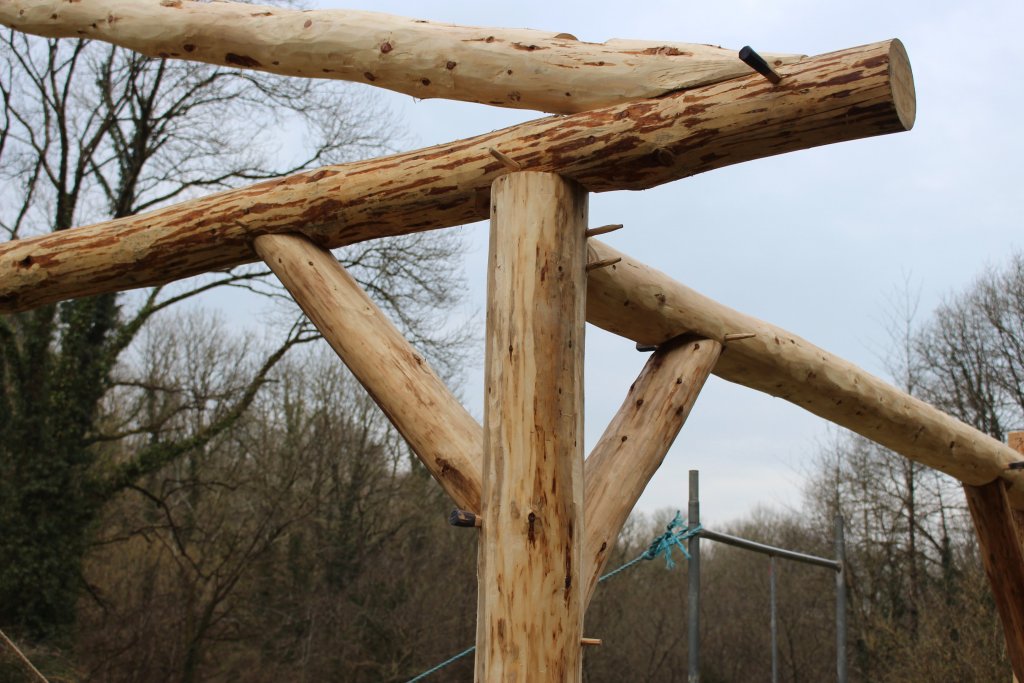
      Talk about getting thrown in the deep end… The first week I found very hard, there was just so much information to take in I was going home with a headache everyday. Like many skills, with practice you get better and I started to gain confidence in my work. The frame itself was large, originally 5 truss sections which included the truss beam which spanned 8m with two principle rafters, a king post and 2 struts. 3 upright poles in each section connected by tie beams and braces. There were a lot of components and not a great deal of time.


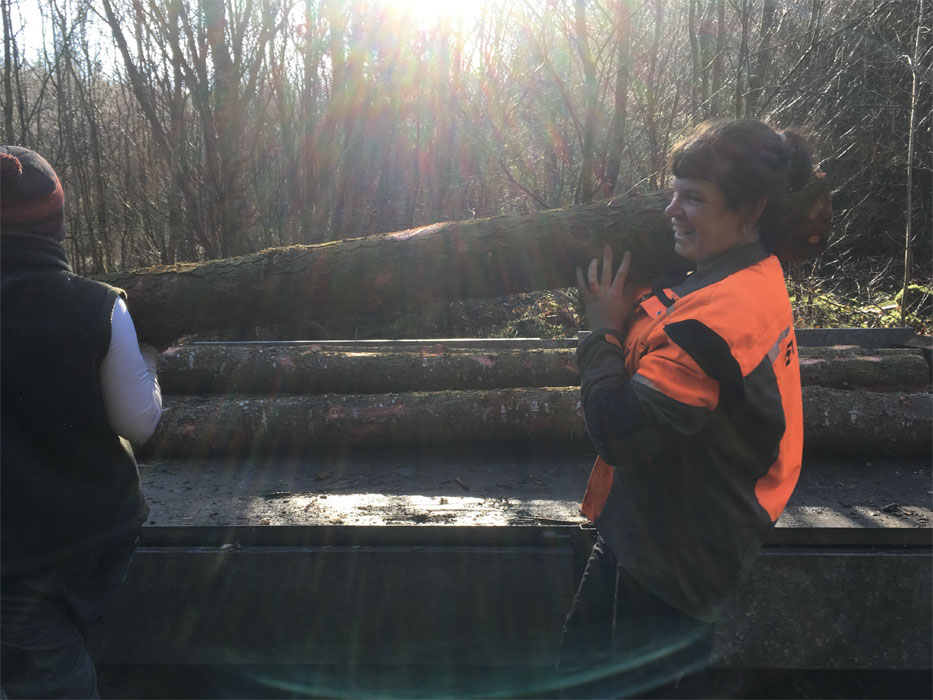
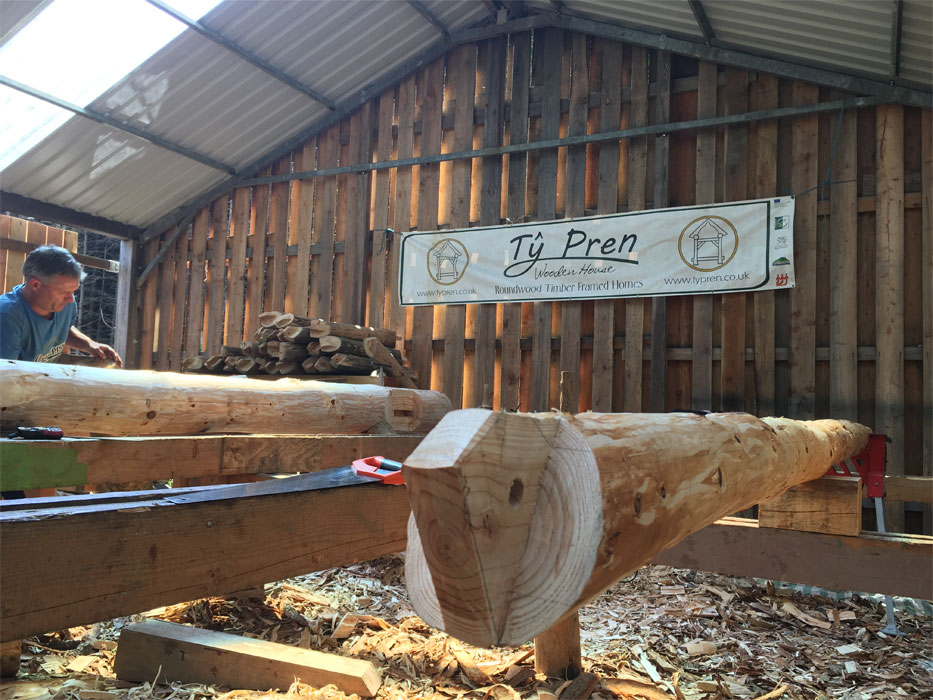
      At Ty Pren we see the whole process through from start to finish. We are lucky to have a workshop situated in 200acres of woodland with areas of larch just right for our frames. We go into the woods and select, fell and then carry out by hand the selected trees.  Once loaded on the trailer we drive round to the workshop, unload, strip and then mark up accordingly the component we want to work on. By carrying out this process ourselves we really keep the cost of the frames affordable and that is at the heart of the Ty Pren ethos. Once you start using machinery, the price starts to creep up. Also working the wood in the round is not only aesthetically pleasing but stronger as you are not cutting into the woods fibres and cheaper as it isn’t processed through a saw mill.  Personally I enjoy this really physical side to the work and its always a laugh to be stumbling through a coniferous plantation carrying a whopping big tree between four of you. Take away the tree and we would look like drunks walking through town on a Saturday night!


      Things were going really well and I was enjoying working with everyone at Ty Pren. The spring weather had been divine and edging into summer was really hot. It definitely got quite sweaty in the workshop finishing the frame for Fordhall Farm. Not long before we were due to finish the entire frame, Fordhall Farm asked us to complete 2 more truss sections and a veranda frame. Well now we were up against it.  As the latest apprentice I really felt the pressure.  I didn’t want to make any mistakes now as it would cost us time we no longer had. We organised to finish the frame working to peoples’ strengths and getting everyone to complete the same components over and over – which was great for me to repeat and learn.


      Finally the day came to load the frame onto the lorry to be driven up to Fordhall Farm. Out of the 5 members of Ty Pren only 3 of us were available to erect the frame. Myself, Cathryn and Jamie. We also had a tele-handler and driver thank goodness as it would have been near impossible otherwise. This was the really exciting part to see how it all came together and how it looked. I was able to see why certain things had to be done a certain way.

      Although we do put the frame together bit by bit in the workshop we still came across a few minor issues which for me is great as I think it’s by getting things wrong and making mistakes that you learn the best.  Everything we talked about in theory was actually coming together in front of my eyes. At the end of the first day we had got two of the truss beams up. Staying on site in various vans and caravans, we all sat and had dinner and a jug of Pimms basking in the glory of our work so far. I don’t think I stopped smiling for weeks. In two days the frame was up, another two days and we had the perlins and the veranda frame up too. And it looked beautiful. I felt so proud to be a part of a team that make such picturesque frames.


      We at Ty Pren believe that our frames could be used in affordable social housing and want to see the building industry meaningfully move towards sustainable building. Given the current alarms being raised by scientists concerning climate change and environmental destruction we really need to start to take responsibility for the future, now. WE use locally sourced FSC standard timber. The frames are extremely low impact as we use hammer and chisel, brace and bit and carpenter saws for most of our work. The frames themselves will stand for hundreds of years. This is the legacy we want to leave behind.


      Since Fordhall Community Farm I’ve completed several frames and I’m still loving the work. One of the great things is the interesting places and projects – such as Rhiw Las and Lammas – it takes me to. Both are projects based on gaining planning through the One Planet Development initiative unique to the Welsh Assembly to help facilitate sustainable, ecological development in open countryside. I hope to one day own land to build my very own ty pren so it’s really informative working alongside people going through the planning process. I’ve learnt so much from everyone I work with and I look forward to building more frames with the crew 🙂

      Written by Tony Eames · Categorized: Uncategorized

      Apr 15 2017

      The Finished Frame- Roundwood Timber Frame Construction

      Blessed with sunny days, Ty Pren has completed the frame of the house, including the workshop, and a drink was shared by all during the ‘topping out ceremony’. Thanks was given to the wood energies that have helped us reach this point.

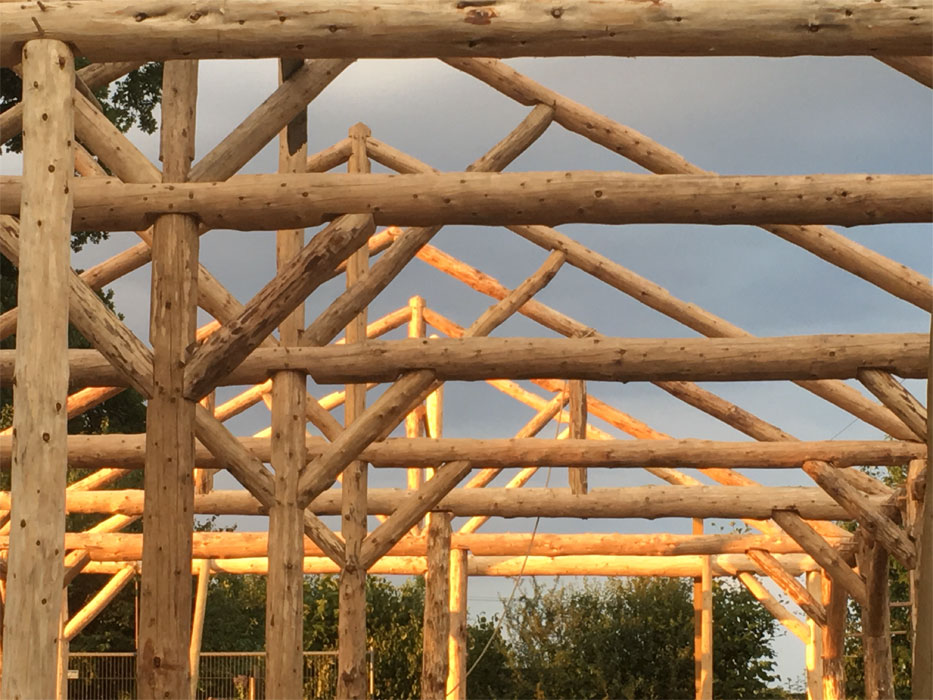
      The completed roundwood timber frame.

      The Ty Pren team has been working efficiently and co-operatively on the roof of the house which is kept as eco as possible using a Pavatex wood fibre board for the insulation and recycled steel for the top layer.

      Traditional timber framing.

      Ty Pren will soon be handing over to Richard Sylvan of Heartwood Natural Building who will lead the installation of the straw bale walls that provide world class insulation value.

      View of roundwood timberframe with workshop frame.

      The five hundred bales will then be rendered with lime and clay plasters under the guidance of Straw Works and Heartwood Natural Building. They will be hosting courses in natural building throughout the summer – see http://www.danyberllan.co.uk/ for details and to get involved.

      Erica and some of the Ty Pren team.

      We have loved building the frame for this affordable home with a very low carbon footprint. It has been nice to be immersed in the ideals that shape the people who come together to create a One Planet Development site like the one at Rhiw Las.

      We wish Erica Chris and Tanwen all the very best in their new home on completion.

      Written by Typren · Categorized: Design, Low impact self build, One Planet Directive, Tourism, Uncategorized · Tagged: low impact, Round wood timber frame, sustainable

      Mar 22 2017

      From Forest to Frame – Future Proof Homes from Ty Pren.

      The current frame is for a family dwelling  at Rhiw Las, which is a group of four low-impact small holdings in Carmarthenshire.  Erica and Chris have been approved for planning through the One Planet Development so a Ty Pren building is ideal for the ecological requirements.

      Our techniques and processes help to reduce the carbon footprint of the build. Ty Pren has been selecting, extracting and framing larch trees from the same woodland for this frame which keeps the transport costs down.

      Felling the trees for the roundwood timber frame home.

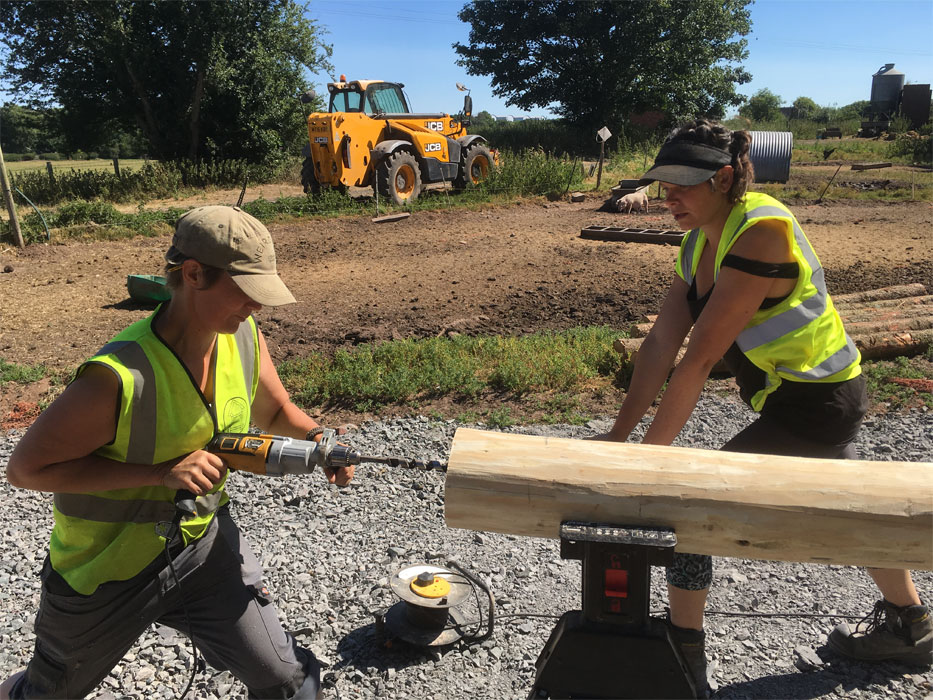
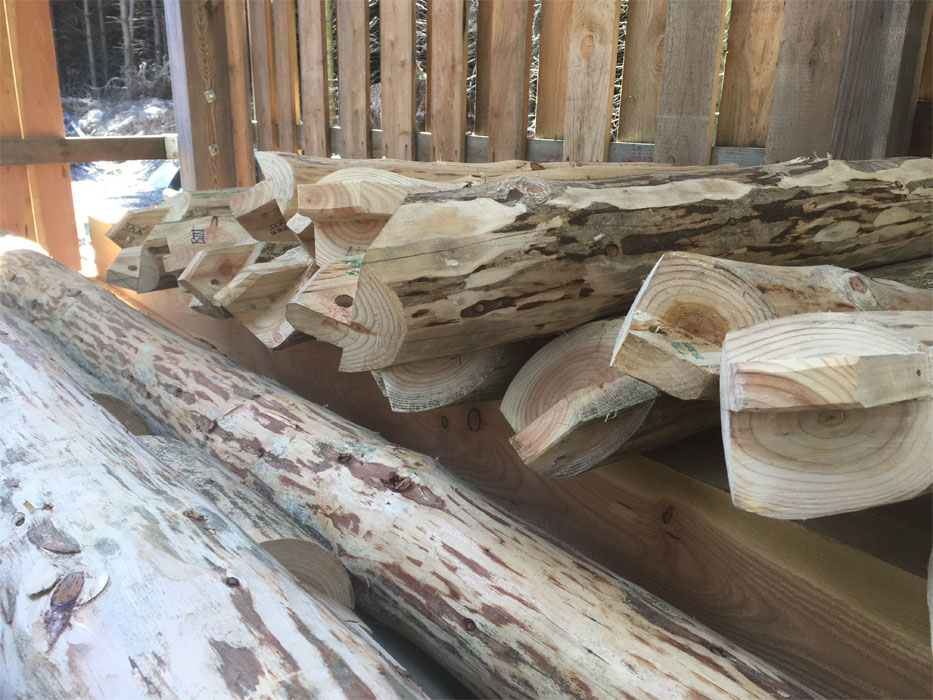
      Using hand tools we have been stripping larch poles and framing them. The larch trees are carefully selected for the needs of the building. The frame is made from primarily round wood which adds extra strength to the building.  The wall plates are square cut and scarved together.

      Inside the Ty Pren workshop.

      Roundwood frame and square cut wall plates.

      The pegs are made from seasoned sweet chestnut.  The green wood that we frame will tighten around the seasoned pegs strenghthening the joint. Some of the pegs are dyed with a solution made from vinegar and wire wool, to distinguish them from other size pegs.

      Sweet chestnut pegs.

      Once the frame was completed it was taken to the site in Carmathenshire on the back on a flat bed lorry ready be raised.

      This is the only transport cost of the timber keeping the CO2 emissions to a minimum. The frame took us all day to load and unload and stack on site.

      Measuring out foundations for roundwood timber frame home.

      Chris and Erica had marked out the plan for the placement of the uprights. We took laser levels and were ready to start raising.

      Once we had raised the first bent Erica and Chris knocked in the first pegs of the building.

      Client knocking in first peg of roundwood timber frame home.

      We have worked well as a team to raise the frame, all putting our heads together to solve any technical issues if they arose.

      Ty pren team raising roundwood timber frame low impact home.

      And so the frame is raised!

      Completed roundwood timber frame for low impact home.

      Prior to the rafters going on there is not a nail in the building.  The rafters have been milled from a tree from the same woodland that the frame came from.

      View of roundwood timber frame home.
      The frame looks fantastic in this beautiful setting.

      The dynamics of the team have changed for this build, Ray and Blue are not currently with us .  We have found two apprentices to work and learn with the team.  Mark and Cathryn have worked very hard honing their skills and have been a real asset. Thank you to volunteers  Emily, Lyka and Ian for helping us along with the build, your contributions were really appreciated and it was great to have you in the workshop, we hope you enjoyed your experience!

      Written by Typren · Categorized: Building, Design, Low impact self build, One Planet Directive · Tagged: low impact, Round wood timber frame, sustainable

      May 30 2016

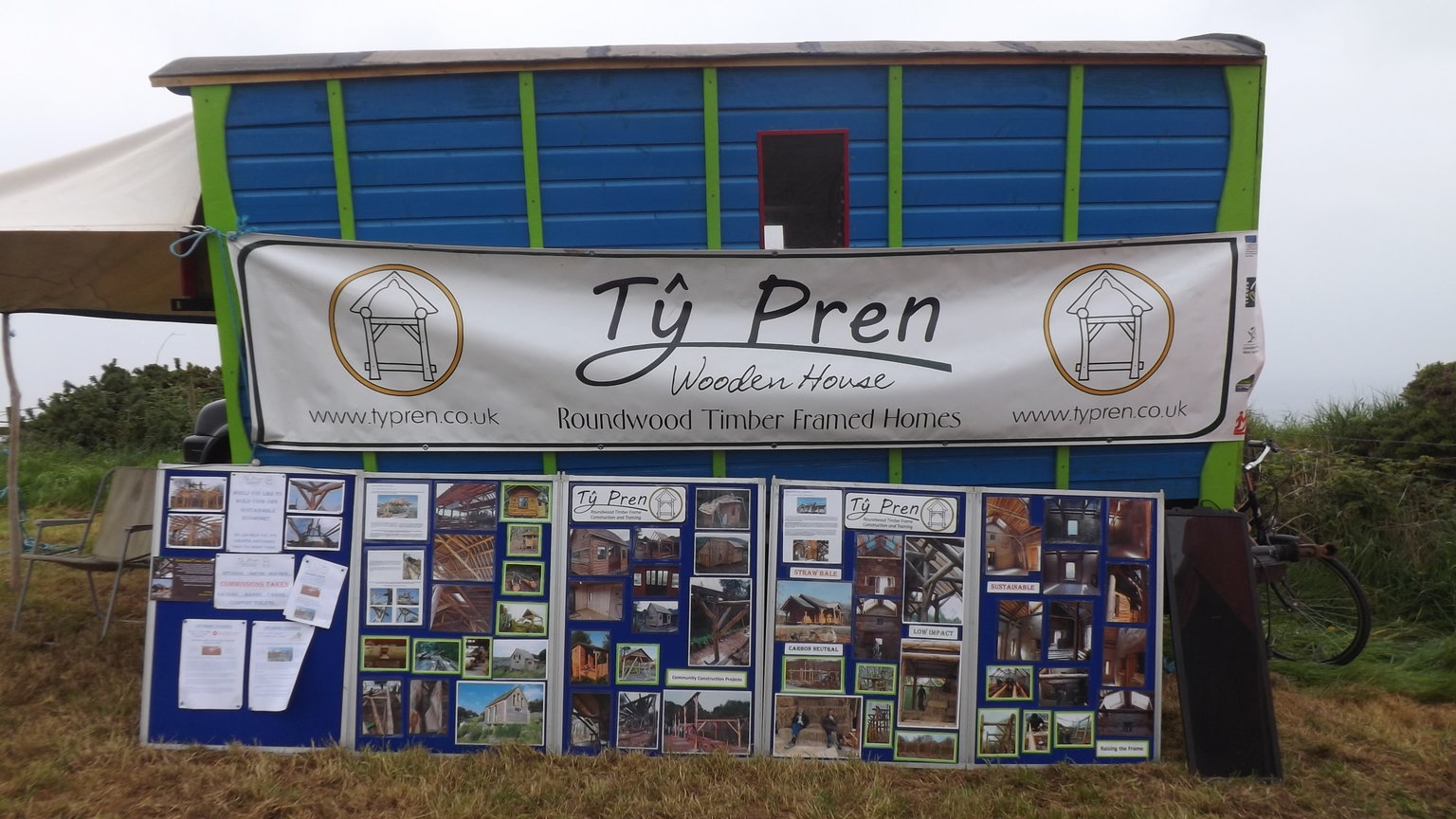
      Ty Pren out and about- Promoting Low Carbon Builds at Coppicewood College

      rsz_dscf7182
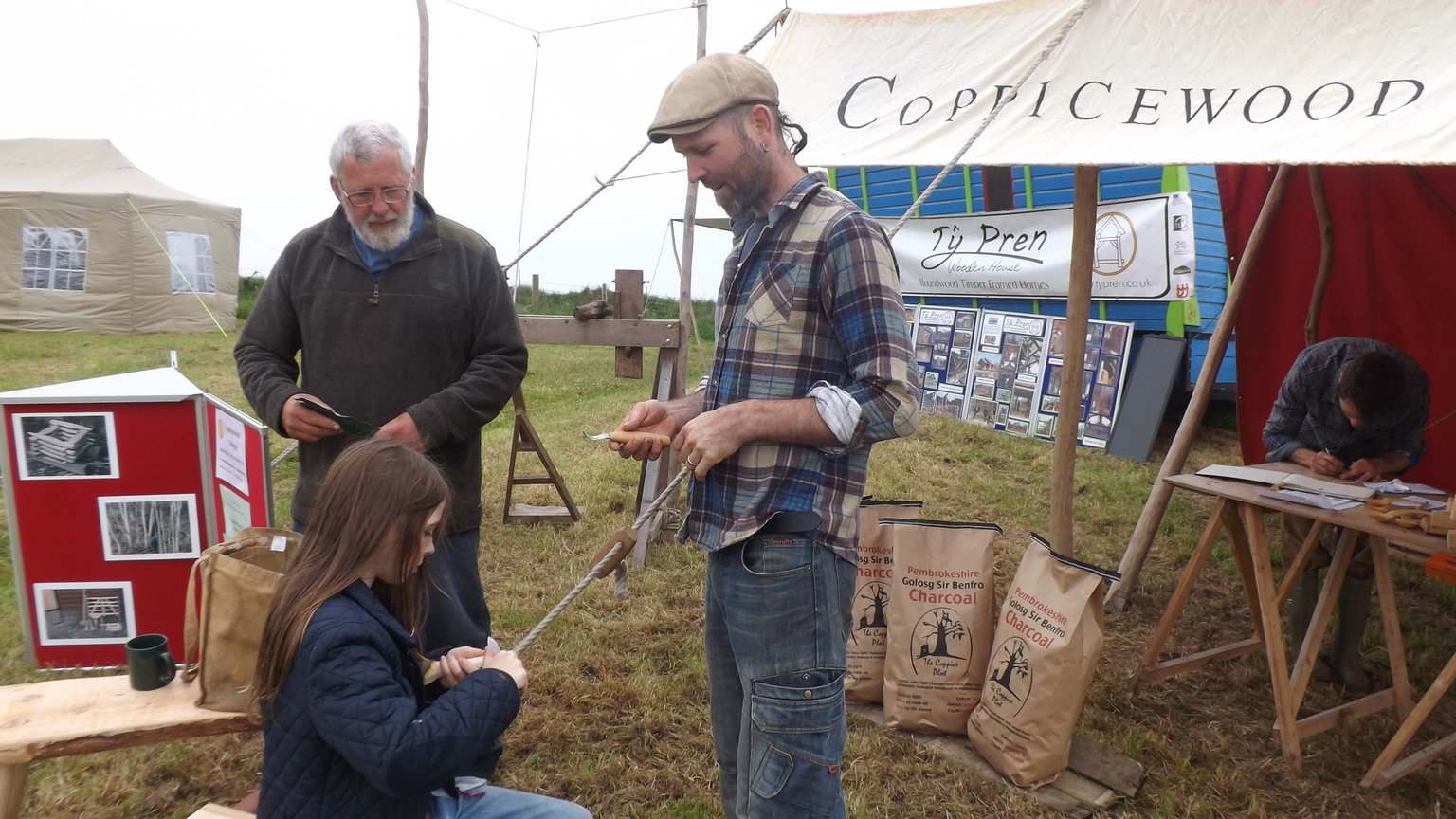
      Ty Pren was invited to join Coppicewood College as part of their 10 year anniversary year celebrations at The Really Wild Food and Countryside Festival in Pembrokeshire. Many of the members of Ty Pren began their woodland craft careers here, learning coppicing, woodland management and greenwood craft skills. We all agree that their course was life-affirming and well worth every penny.rsz_dscf7186

      It was great to meet and work alongside Martin, David and Andrew, who helped our daughter make quite a lot of spoons, so many thanks to him for that! We also enjoyed talking to so many people at the festival, we hope to be a part of some of your exciting projects in the future.

      rsz_dscf7317

      The Really Wild Food and Countryside Festival was a lovely event; we especially enjoyed the brownies, the pizza and the cider! The view of the beautiful coast was beautiful too, and watching the mud runners was both amusing and inspiring; thanks to everyone involved for a great weekend!

      rsz_dscf7235

      If anybody is interested in Roundwood Timber Framing Courses, here are the links: C.A.T. and Denmark Farm.

      Written by Typren · Categorized: Uncategorized

      • 1
      • 2
      • Next Page »
      • Our Mission
      • Work With Us
      • Testimonials
      • Contact

      © Copyright 2015 TyPren · All Rights Reserved · Powered by WordPress